Mid-season Collection: Women - Men Delivery 24/48h, Free from €90 Satisfaction Guaranteed or Money Back

The largest selection of hats in France


You've just acquired a magnificent panama and you're wondering how to transport it without damaging it? Rolling this exceptional headwear requires real know-how. Far from being a simple storage technique, it's an ancestral art that preserves the integrity of the fibers while facilitating your travels.
Contrary to popular belief, rolling is not the same as folding. This nuance, however subtle, determines the longevity of your investment.
.jpg) Bailey Roll Up natural hat, available on the Traclet website.
Bailey Roll Up natural hat, available on the Traclet website.
Why roll rather than fold?
The difference between rolling and folding lies in the very physics of materials. Rolling follows the natural curvature of toquilla fibers, these plant strands that constitute the soul of the panama. Folding, on the other hand, imposes brutal right angles.
Imagine a tree branch: you can bend it gradually without breaking it, but a sharp fold will instantly snap it. The principle remains the same with your hat.
This respectful approach explains why some models support rolling while others require transport in a rigid box. It all depends on their construction.
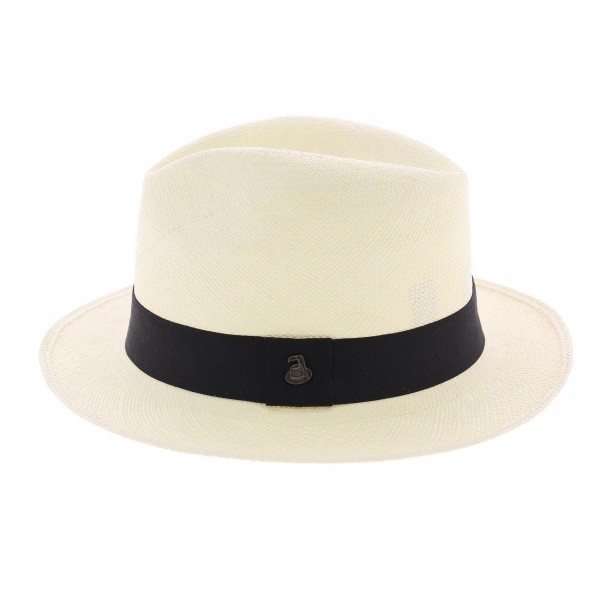
the foldable Traclet model, available on our online store.
.jpg "Panama hat - chapeau panama")
Not all panamas are equal
Here's a reality that many ignore: the rolling capacity depends directly on the fineness of the weaving. The tighter and more regular the stitches, the more the hat tolerates this delicate manipulation.
Montecristi panamas, considered the Rolls-Royces of the genre, roll with disconcerting flexibility. Their extremely fine fibers allow manipulations impossible on entry-level models.
Conversely, a panama with loose weaving risks permanent deformation. It's better to opt for traditional transport rather than taking unnecessary risks.
The step-by-step technique
Rolling begins with a firm but delicate grip of the crown. With one hand, hold the top while the other gradually smooths the edges downward.
Then comes the crucial step: inverting the natural curvature. Gently push the top outward from inside the hat. This action may seem counterintuitive at first, but it prepares the fibers for rolling.
The rolling itself is done in a spiral. Start at one edge and progress toward the other with constant pressure. Neither too hard to avoid marks, nor too light to maintain cohesion.
Some enthusiasts make the mistake of wanting to go too fast. Take your time: good rolling requires patience and delicacy.
Pitfalls to absolutely avoid
First pitfall: forcing a recalcitrant hat. If your panama resists rolling, it's probably because its quality doesn't allow it. Insisting would irreversibly damage the weaving.
Second common mistake: rolling too tightly. The marks thus created on the fibers can become permanent, particularly on new models whose fibers have not yet acquired their final flexibility.
Third pitfall: considering rolling as a permanent storage solution. This technique should only be used for temporary transport. A constantly rolled panama loses its original shape and develops lasting deformations.
The often overlooked influence of climate
Atmospheric conditions play a determining role in the success of the operation. Natural fibers react to variations in humidity and temperature like a living barometer.
In dry weather, the fibers become brittle. A light preliminary moistening, obtained by hanging the hat in a bathroom after a hot shower, greatly facilitates rolling.
Conversely, excess humidity excessively softens the fibers. The hat then loses its hold and risks deforming during handling.
The comfort zone is between 18 and 22°C with humidity of 45 to 55%. Conditions rarely met naturally, hence the importance of adapting your technique.
The accessories that make the difference
A rigid tube completely transforms the transport experience. Thick cardboard, leather or composite materials, the essential element lies in the rigidity and appropriate diameter.
Some manufacturers offer specially sized cases. These accessories, while representing an additional investment, guarantee optimal protection.
In the absence of specialized equipment, tissue paper constitutes an acceptable alternative. Delicately wrap the hat before sliding it into a rigid cylindrical container. Avoid plastic which promotes condensation.
Returning to the original shape
Unrolling requires as much care as the reverse operation. Progress slowly, in the opposite direction of the initial rolling.
Warm water steam then becomes your best ally. No need for sophisticated equipment: steam from a kettle is sufficient. Hold the hat at a respectful distance to avoid any direct contact with water.
Reshaping is done only by hand. Respect the original shape without trying to "improve" the initial design. Ecuadorian artisans have mastered their art for generations.
Let it dry naturally at room temperature. Forced drying with a hair dryer or near a radiator would permanently damage the fibrous structure.
When rolling is not possible
Not all panamas can withstand this manipulation. Entry-level models, whimsical creations or old hats require other solutions.
Transport in a rigid box remains the absolute reference. Certainly more bulky, this mode of transport perfectly preserves the shape and avoids any risk of deformation.
Nesting with other headwear represents a savvy traveler's trick. Place the hats inside each other, from largest to smallest, inserting tissue paper between them.
Regular maintenance considerably extends the lifespan. A soft brush is sufficient to eliminate dust and impurities. Storage on a form or suspended preserves the silhouette between uses.
Your panama, companion for all your travels
Mastering the rolling of your panama opens new horizons. This exceptional headwear then becomes a true travel companion, ready to accompany you to the four corners of the world.
This technique, inherited from ancestral Ecuadorian craftsmanship, testifies to the respect owed to these unique creations. Each panama tells a story, that of the expert hands that shaped it with patience and know-how.
So, the next time you pack your bags, you'll know how to preserve the timeless elegance of your personal style while keeping your panama within reach.