Mid-season Collection: Women - Men Delivery 24/48h, Free from €90 Satisfaction Guaranteed or Money Back

The largest selection of hats in France


Who hasn't smiled seeing Charlie Chaplin strolling with his famous bowler hat? This very particular accessory, immortalized by Charlot, René Magritte or John Steed in "The Avengers," hides a story much richer than one might imagine. Behind this recognizable shape lies a fascinating tale that takes us from the English countryside of the 19th century to contemporary fashion runways.
But where exactly does this name "bowler hat" come from? Why do the English call it "bowler hat"? And how did a simple utilitarian accessory become a true cultural icon? Let's dive into the captivating world of this headwear that has crossed eras without aging.
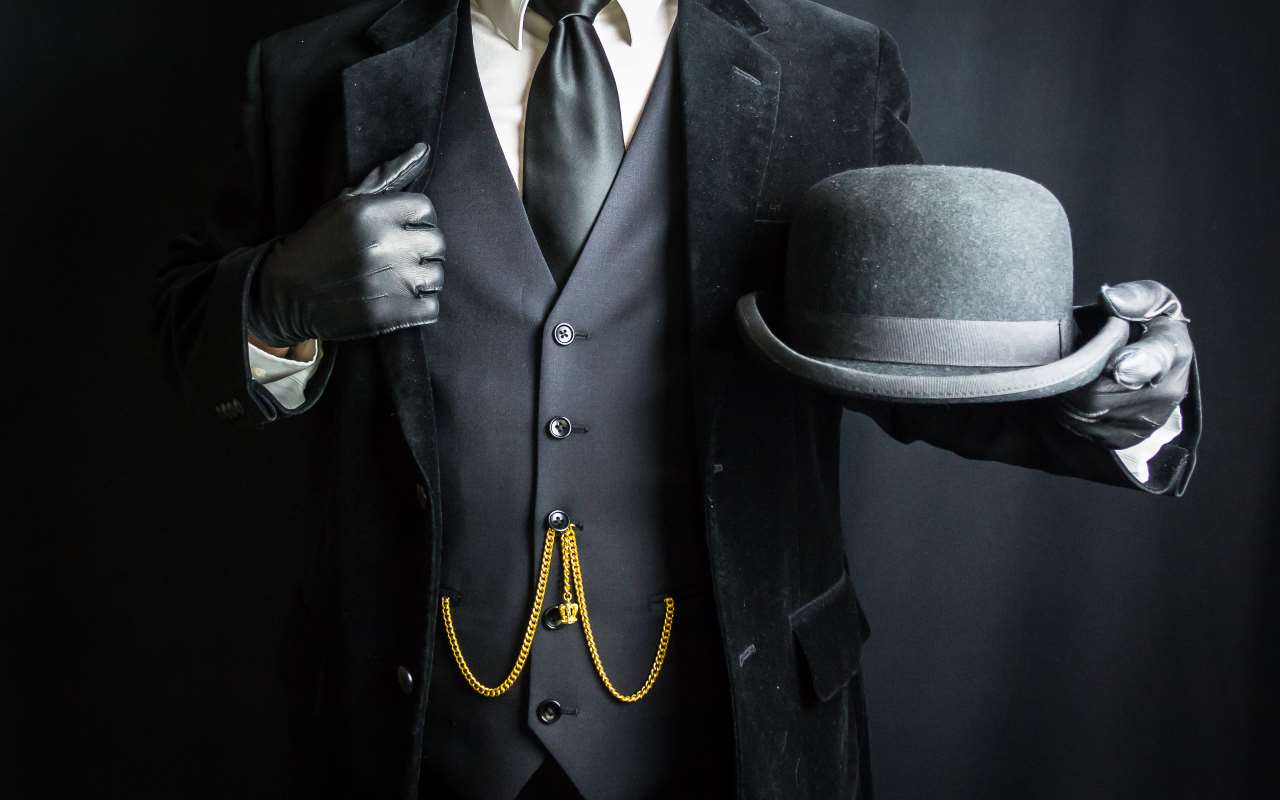
1849: the birth of a revolutionary hat
It all begins with a very concrete problem. Edward Coke, nephew of the Earl of Leicester, is tired of seeing his gamekeepers and forest rangers damage their top hats during their missions. These elegant hats, perfect for London high society, prove totally unsuited to the realities of the field.
Branches catch the brim, the height poses problems when passing under foliage, and the fragility of traditional felt doesn't withstand rural activities. A solution must be found! Edward Coke has a precise idea in mind: a hat as rigid as a top hat, but lower and above all more resistant.
On December 17, 1849, he walked through the door of James Lock & Company, a renowned hattery in London. His request was clear and precise. He wanted a special model, custom-designed for the specific needs of his employees. The establishment accepted the challenge and entrusted the creation to two talented hat-making artisans: brothers Thomas and William Bowler.
From "Coke hat" to "bowler hat": the evolution of a name
Logically, this new hat first takes the name of its commissioner. It's then called "Cokehat" (pronounced "cook"), in honor of Edward Coke. But the Bowler brothers will leave their mark on history.
These London hatters, established in Southwark, perfectly mastered their craft. They created a revolutionary model that exactly met Edward Coke's expectations. The anecdote tells that before finalizing his purchase, Coke tested the hat's durability by... stepping on it! The headwear withstood the test, and our man left satisfied after paying 12 shillings.
Success was immediate. Quickly, this new type of hat became popular far beyond gamekeepers. The bourgeoisie adopted it, as did the working classes. And naturally, people began calling it "bowler hat" after its creators' name. A linguistic evolution that imposed itself naturally.
In 1862, even the future King Edward VII wore it during an official visit to a hospital. The bowler hat had definitively left the forests to conquer the salons.
Why "melon" in French?
Here's a French peculiarity! While the English kept the name "bowler," the French chose a much more... poetic name. "Melon." Just like that.
The reason? It jumps out at you as soon as you observe the characteristic shape of this hat. That perfectly domed crown, those rounded contours, that generous silhouette... everything irresistibly recalls the fruit of the same name! French hatters, always quick to cultivate the art of metaphor, couldn't resist this visual evidence.
This linguistic differentiation also reveals a distinct cultural approach. Where the English favor a reference to the artisan creator, the French prefer a concrete, familiar image. An approach that perfectly reflects the spirit of each country in its relationship to fashion and accessories.
In Belgium, there's an amusing variant: "chapeau boule." Another reference to its characteristic roundness!
The manufacturing secrets of an exceptional hat
Creating a genuine bowler hat is no joke. The Bowler brothers developed a manufacturing process that was revolutionary for the time. The secret? A sophisticated chemical treatment that transforms ordinary felt into ultra-resistant material.
The original recipe calls for a very special lacquer, composed of a surprising mixture: black molasses obtained from the sap of an insect from the Far East, mixed with alcohol. This preparation, applied to the felt, hardens it considerably.
Next comes molding on a wooden form, perfectly calibrated. Each hat is shaped individually, then sanded with sandpaper to achieve that characteristic smooth surface. Goldsmith's work that explains the exceptional quality of these accessories.
This technical innovation represented a true leap forward in the hat industry. Finally, there was a headwear combining elegance and robustness! A feat that would quickly gain traction throughout Europe.
A meticulous artisanal process
Every step counts in creating an authentic bowler hat. After chemical hardening, artisans proceed with precise shaping of the domed form. The edges, slightly raised, require particular attention to achieve that recognizable curve.
The sandpaper finish is not insignificant: it guarantees that perfectly smooth texture that catches light so well. A detail that makes all the difference between a simple hat and a true bowler hat!
The golden age: when the bowler became a symbol of respectability
Between 1880 and 1920, the bowler hat experienced its absolute heyday. Gone was the simple utilitarian accessory! It became THE symbol of male respectability, particularly in England but also throughout Europe.
The picture-postcard image of that era? A mustachioed gentleman, squeezed into an impeccable three-piece suit, proudly sporting his bowler hat. This combination becomes the dress code of the rising bourgeoisie and working classes aspiring to social advancement.
Because that's the real strength of this accessory: it transcends social barriers. The London banker and the ambitious worker wear the same hat. A remarkable democratization for the time!
Men went out wearing their bowler hats, which they happily paired with frock coats and bow ties for more formal occasions. Going to the office, attending the theater, participating in a reception... the bowler hat was worn everywhere.
A fascinating social phenomenon
This popularity reveals something profound about Victorian and post-Victorian society. The bowler hat perfectly embodies the spirit of the era: technical progress in the service of elegance, social ambition accessible to all, modernity that doesn't forget codes.
Even American outlaw figures adopted it! Butch Cassidy and Billy the Kid proudly wore their bowler hats, breaking the traditional image of the cowboy with the wide-brimmed hat. An irony of history: the "real" hat of the conquest of the West wasn't the Stetson, but the bowler hat!
One hat, a thousand names across countries
The bowler hat's journey around the world gave birth to a rich variety of names. Each country, each culture found its own name to designate this very particular accessory.
Across the Atlantic, Americans called it "derby hat," named after the horse races where it was widely worn. In some British regions, it's still called "billycock," a more rustic reference to its country origins.
Belgium opted for "chapeau boule," favoring like France a reference to its shape. In South America, particularly in Peru and Bolivia, "bombín" prevailed. There, curiously, it's mainly women who wear it!
This terminological diversity testifies to the remarkable adaptation of this accessory to different cultures. Each country appropriated it, giving it a name that corresponds to its own aesthetic or cultural vision.
Surprising local stories
The story of the South American bombín deserves a closer look. According to legend, it all started with an ordering error! A large shipment of hats, intended for British railway workers, arrived in the wrong color. Rather brown than black...
Rather than return the merchandise, importers reportedly offered it to Aymara and Quechua women migrating to cities. They were even told that wearing the bombín would promote their fertility! An anecdote that perfectly illustrates the unpredictable paths of fashion.
When the bowler hat becomes legend
It's impossible to mention the bowler hat without immediately thinking of its most famous ambassadors. Charlie Chaplin and his character Charlot probably did more for the worldwide fame of this accessory than all the hatters combined!
This recognizable silhouette - the swaying walk, the cane, the mustache and of course the bowler hat - marked entire generations. Charlot transformed a symbol of bourgeois respectability into an emblem of burlesque poetry.
Laurel and Hardy continued this tradition, immortalizing the duo of bowler hat and comedy. Hard to imagine these two companions without their favorite headwear! Their bond with this accessory is an integral part of their charm.
In literature and detective cinema, Simenon's Inspector Maigret long wore the bowler hat before Jean Gabin preferred something else in "Maigret Sets a Trap" in 1958. A change that symbolically marked the beginning of this accessory's decline.
Magritte and the surrealist dimension
René Magritte deserves a chapter of his own in this story. The Belgian painter elevated the bowler hat to a true artistic obsession. "The man in the bowler hat," "The Son of Man"... his most famous canvases feature this accessory that became a symbol of modern man in all his complexity.
With Magritte, the bowler hat loses its social dimension to acquire a philosophical scope. It embodies the anonymity of the contemporary individual, standardization, but also the mystery hidden behind appearances. A fascinating artistic metamorphosis!
John Steed, the hero of "The Avengers," gave this accessory a second youth in the 1960s. Elegant, distinguished, always impeccably dressed, he modernized the image of the bowler hat for a new generation.
The decline then rebirth
After the 1950s, the bowler hat experienced a gradual but inexorable decline. Dress codes evolved, society became more relaxed. The borsalino, more flexible and comfortable, gradually took its place in the male wardrobe.
This evolution reflects the profound societal changes of the post-war period. Victorian rigidity gives way to a more relaxed approach to elegance. The bowler hat, with its symbolism of constrained respectability, no longer fits the spirit of the times.
However, it never completely disappeared. Some social events continued to require it: the Prix de Diane in Chantilly remains an unmissable event where gentlemen in bowler hats rub shoulders with ladies in extravagant hairstyles. A tradition that endures...
Subcultures also seized upon it. The punk movement, always fond of subversions, adopted the bowler hat as a symbol of chic rebellion. A delicious irony when you know its bourgeois origins!
The contemporary comeback
In recent years, we've witnessed a true comeback of the bowler hat. Vintage fashion is gaining followers, younger generations are rediscovering the charm of classic elegance. Designers no longer hesitate to revisit this timeless accessory.
Contemporary artists continue to draw inspiration from it, fashion photographers bring it back into style. The bowler hat crosses eras while keeping its power of fascination intact.
An enduring legacy
From Edward Coke's pragmatic commission to contemporary fashion runways, the bowler hat has written a unique history. This accessory born from a practical need became much more than a simple headwear: a cultural icon, an artistic symbol, a social marker.
Its nomenclatural evolution - from "Coke hat" to "bowler hat," from "bowler" to "melon" - testifies to its remarkable adaptability. Each era, each culture has appropriated this object by giving it its own color, its own meaning.
Even today, wearing a bowler hat leaves no one indifferent. Whether seen as a vintage nod, an artistic reference or simply a bold aesthetic choice, this accessory continues to be talked about.
Lovers of fine millinery know how to recognize a genuine bowler hat: that distinctive shape, that incomparable felt quality, that artisanal know-how that spans the centuries. Because beyond fashions and trends, the excellence of an object designed to last remains.
The bowler hat has managed to span more than a century and a half while keeping its singular charm intact. A longevity that testifies to the accuracy of its original design and its timeless evocative power. No doubt it will continue for a long time to make lovers of elegance and history dream!